Saturday, February 26, 2022

The Untitled Story : Part 2

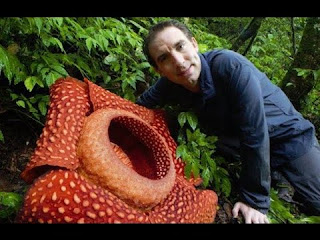
Rafflesia sp.
Courtesy: https://www.youtube.com/watch?v=0cGRujABwuQ


After searching the internet for long hours about the fictitious as well as suspicious Blue Rafflesia Raj and Rohit found no reliable information regarding the plant. However, there is a lot of information about Rafflesia and its recognized species. In a gist which can be delineated below:

The Rafflesia is a member of the Rafflesiaceae family and is one of the world’s largest flowers.  Rafflesia arnoldi, which is a species of Rafflesia can grow up to 150 cm in diameter which entitles it the largest flower in the world.

Rafflesia arnoldi was first identified in Sumatra by an exploration party led by Sir Stamford Raffles, his wife Lady Sophia Raffles, and his doctor and naturalist Dr. Joseph Arnold. They visited the Pulau Lebar on the Manna River on either 19 or 20 May 1818.

At the time of their visit a local servant first discovered a very large flower and led Dr.Arnold to it. Arnold thus became the first person from the exploration party to see the Rafflesia. The flower was large, measuring a full yard across. Dr. Arnold described seeing “a swarm of flies hovering over” the flower and laying their eggs in it, and it produced “precisely the smell of tainted beef”. He proceeded to remove the flower and sent the specimen back to Manna, but the specimen was later found to have turned brown and infested with maggots. In addition, he also made a coloured drawing of the flower.

The Rafflesia is found in the tropical rainforests of Borneo, Sumatra, Java, Peninsular Malaysia, Thailand, and the Philippines. It occurs only in certain habitats as a parasite on the Tetrastigma species of woody vines.

It is a very rare flower, difficult to reproduce in laboratories and its dried specimen is difficult to preserve. The Rafflesia can measure between 36 to 42 inches in diameter and weigh between 9 to 12 kg.

Since all the plants of this family are parasitic, they do not have any roots, stems, or leaves and lack chlorophyll. Individual flowers or buds simply sprout on the species of Tetrastigma woody vines. Some flowers are monoecious, with both sexes in the same flower.

Prior to the discovery and introduction of this flower to the western world, the indigenous communities who had known about its presence were using the Rafflesia for medicinal purposes. Rafflesia buds were used by women to stop internal bleeding and shrink the womb after childbirth.

In particular, it was used as a love potion and to hasten childbirth by the Sakai tribes in Malaya, and as an aphrodisiac and astringent by high society women in Java.

 In spite of its various uses, the chemical composition of Rafflesia flowers has not been extensively analysed yet. However, preliminary phytochemical screening has shown no evidence of the flowers’ medicinal properties. On the contrary, the buds and flowers have a high content of tannin and phenols that can be toxic when taken in large quantities.

In Thailand, young buds of the flower are eaten as a delicacy.

The scent of Rafflesia which varies in intensity from one species to another is just like rotten meat and as a result, it attracts carrion flies. The smell is maximum at around noon and on the third or fourth day of the bloom. That is why this plant is also referred to as "corpse lily” and “carrion flower” in English. 

This species is often confused with another species known as Titan arum which is referred to as “corpse flower,” 

Rafflesia has never been cultivated in captivity. Even after 180 years of its discovery lot of features, behaviors, phenology, and genology of the species is unknown. The main reason for this is their rarity. These flowers are only found in remote areas in the forest of South East Asia. As the forest cover is decreasing the occurrence of this species in wild is also decrementing. The buds are harvested and sold for their purported medicinal qualities and as a result, even if the flower is visible in some places it is not guaranteed that they will be available in the same place next year due to lack of protection.

So from the gist, it can be well understood that the Rafflesia itself is very rare. Till now 17 different species of Rafflesia have been discovered all of which are extremely rare and their occurrence in the same location is not assured. Now Blue Rafflesia is never been seen neither in wild nor in captivity. So it is indeed a fictional species as informed by Mr.Gomez.

Raj and Rohit were exhausted after a long day in front of their Laptops. So they were having a cup of tea to re-energize themselves. They were discussing the mysterious images of Blue Rafflesia and the images of the species sent to Mr.Gomez when the phone rang multiple times. Raj picked up the call.
"Images are authentic" yelled Mr.Gomez at the other side of the call. "The emails were sent from someone who had opened his email account from Bhubaneswar. Further investigations are going on. Just now Cybercrime and Forensic dept informed me. I will come in the evening to discuss one more piece of news that I have received from my sources.". With this, Mr.Gomez put down his phone.

My first tryst in storytelling. If possible give some feedback, please.

Reference

Wednesday, February 23, 2022

The Untitled Story : Part 1

"Do you know about Rafflesia ?" Ask Mr.Gomez, a tall man with average health. He is a spectacled guy working in the Detective Department for the last 10 years.

"Yes, it is a plant having the largest flowers in the world.", Raj stops to take a breath and then continues "it attracts flies and other insects with its enormous flowers, which pollinate the plant so it can continue the reproductive process. It has dimethyl disulfide, which contains sulfur that creates a rotten smell. The flower of one of its species that has the world's largest bloom is the Rafflesia arnoldii. "

"This rare flower is found in the rainforests of Indonesia. It can grow up to 3 feet across and weigh up to 15 pounds! Thriving in rainforests, Rafflesia is in danger of extinction due to habitat loss as well as poaching — its buds are harvested and sold for medicinal properties. The plant cannot grow in captivity, and, as most occurrences of Rafflesia contain only male or female flowers, pollinations are rare. There are 28 known species of Rafflesia and 10 species are listed in the largest flower category in the world."

"Oh, you know a lot about Raflasia it seems." Mr.Gomez interrupted Raj .

" But my problem is not about the Rafflesia but a modified genus of it which are unpopularly known as Blue Rafflesia. It is a very big flower at least ten times larger than the biggest species of Rafflesia and has a smell which can be sniffed within a one-kilometer radius."

"The alarming point is this Blue Rafflesia is an imaginary concept to me until yesterday. But today at around three am, I received an email containing the pictures and claiming that the sender of the email has found real evidence of Blue Rafflesia in the Island of Andaman & Nicobar."

Andaman Nicobar Islands is famous for its absolutely stunning beaches, rich biodiversity, beautiful marine ecosystem, and tropical evergreen forests teeming with wildlife. Andamans serve as a maritime boundary between the Bay of Bengal to the west and the Andaman Sea to the east. The Andaman and Nicobar Island are a Union Territory of India however the Coco Islands and Preparis Island are part of the Yangon Region of Myanmar.

The Andaman Islands are home to the Andamanese, a group of indigenous people that includes a number of tribes, including the Jarawa and Sentinelese tribes. While some of the islands can be visited with permits, entry to others, including North Sentinel Island, is banned by law. The Sentinelese are generally hostile to visitors and have had little contact with any other people. The government protects their right to privacy.

Raj Roy is a handsome-looking boy of 38 years with a bright complexion. He is not very tall as Mr.Gomez but not short either, he stands at a height of 5ft9inch. Raj works freelance and has a keen interest in "not real but possible"  objects. He is junior to Mr.Gomez but a very good friend of the detective. Raj's best friend of equal age is Rohit. Rohit is little fatty but is extremely fit. He is an athlete but has a common interest as Raj that is in "not real but possible" objects. Raj and Rohit, both of the same age, we're the best friends from their school days. During college, they move towards different paths. Where Raj becomes an Engineer, Rohit pursued life science and now works as a scientist in a national level institute.

All three were discussing the pictures of Blue Rafflesia that was sent to Mr.Gomez in Raj's drawing-room.

This room is well lit with all types of sophisticated furniture. Raj and Rohit were sitting on the sofa whereas Mr.Gomez was sitting in the wooden chair as he has a problem of Back Ache.

"The biologists of our Dept, Ms.Runu Kar have said that this is a fraud and someone is joking with me. However, the type, texture, and floral pattern of the flower in the image indicate that this flower is indeed Blue Rafflesia. If the images are real then these pictures are the first image of Blue Raflesia".Mr.Gomez concluded with a hoarse voice. "But we all know that this flower does not exist in real life," Raj replied excitably.

"Have you verified the authenticity of the images? Whether or not they have been photoshopped or superimposed on some other images?"..Raj queried Mr.Gomez. The officer was looking at the sweets and coffee placed on the table for him and was about to grab one of the sweets. He nodded his head on both sides while giving a bite on his favorite food and said "No". 

"Yesterday night I received the email. Till now I have forwarded the email to Ms.Runu only and then in the morning I rushed to your house. Now I will send the images to the forensic and the email to the cyber security cell for verification of the images and to identify the sender respectively. I will inform you regarding their response." Mr.Gomez left the drawing-room for his office.

Raj looks after Rohit and starts to search the internet for more information regarding Blue Rafflesia.

----------------------------------

My first tryst in storytelling. If possible give some feedback, please.

Thursday, December 9, 2021

Seven Trends in "Research towards Sustainability"


Due to various atrocities with the natural resources of the World, the global equilibrium has been compromised. To resist and revert to our sustainable future, our topic of research must move towards projects with sustainable innovation. To create the "World with Sustainable Future", the entry-level researchers must march towards sustainability not only to accomplish their career goals but to develop projects that can ensure our future generation about their comfortable co-existence. The seven most promising trend that is depicted below indicates where we must encourage our innovators to innovate, such that the World become sustainable for its future.

View the complete blog


Originally from HYDROLOGY NEWSLETTER

Monday, October 4, 2021

Five Most Serene Waterbodies to Camp in the North East India


Camping is an exterior activity where people stay overnight away from home in a tent or a recreational vehicle. The founder of modern recreational camping was Thomas Hiram Holding."In 1853 he crossed the prairies of the United States in a wagon train, covering some 1,200 miles (1,900 km) with a company of 300". However, the first possible public camping ground is Cunningham's Camp on the Isle of Man, between England and Ireland which was established in 1894.

Read the full post in TTM.

Friday, April 16, 2021

Published my first Lecture Notes


Published my first Lecture Notes through Gumroad.
It is about the MCDM techniques.
Total six techniques were discussed here along with an example, case studies and practice problems.
It's a digital download and the cost is only 9.95 dollars one time.
Give a visit and reply to me with feedbacks.

Thank you
Here is the link for Indian Buyers :
https://www.instamojo.com/baipatra/lecture-notes-on-mcdm/
And  for Foreign Buyers :
https://gumroad.com/l/zuPVt 

Sunday, May 24, 2020

Invitation for Collaboration : Impact of Lockdown and Urbanization on Water Filter Production

The "Impact of Lockdown and Urbanization on Water Filter Production" can be one of the most important topic of research  related to water reuse in the coming decade. According to Falkenmark's Water Stress Indicator,a region is said to be water scarce if per capita water availability is less than 1700 cubic m.Again availability of water will imply not only the quantity but also the quality of water available.The water must be qualitatively suitable for consumption.Otherwise, it will not be added to water resources potential of a region.    

In the last few years due to large scale and rapid urbanization, there is an immense stress on the "available water".

Not only urbanization, recent lock-down measures are also influencing the quality of water to be changing. Although impact of urbanization will be detrimental to the environment,lock-down affects can act as beneficial to the environment.

In case of lock down citizens can not go out and pollute different bodies of surface water. But amount of water available for consumption is constant.Thus it will be interesting to see the variation in quality of water in between pre and post lock-down scenario.

Based on the surface water or ground water or waste water quality decisions may be adopted for the utilization of supplied water by recycling or reused resources of water.

Hence,the interrelationship between rate of urbanization, lock-down and quality of the surface-water will be an interesting aspect to determine.The potential of urban population in degrading the quality of water in one hand and the beneficial effect from Lock down due to CORONA is also another potential area of research which can enlighten us to determine the amount of water we have and can reclaim for reuse. The results of the study can be utilized not only for decision making by the city managers but also for the common man who want to procure a filter and based on the results he/she may take their decisions. 

If you are interested to do research in this field kindly collaborate with me by replying to this blog post.

For more such invitations visit http://www.baipatra.ws

Edit 1 : Thanks mithan for identifying the mistake.I have corrected the threshold value.


How to reduce your room temperature without any AC or other cooling machines ?

You can reduce the temperature of your room if you have the following : 

1.An Aquarium full of fish and live plants 

2.Silica Gel 

3.Dwarf Bamboo Tree 

When you put the above three items in your room just under the window, room temperature will be reduced drastically.

When you put the above three items in your room just under the window, room temperature will be reduced drastically .

Logic :

Heat will always flow from higher to lower temperate region. In summer, outside temperature is more than room temperature. So, heat enter our room and increase the temperature so that an equilibrium can be achieved. But in turn this incoming heat raise the temperature of the room.

During summer air is full of moisture. When the relative humidity is very high we face a sultry condition. 

So to reduce the incoming heat we will need something more cooler than our room. And to reduce the moisture we need something that  can absorb it.

Aquariums are much cooler than our room. The fish in the aquarium cools it further as they are cold blooded. Thus making the adjacent places cooler. You can feel this phenomena by visiting any gift shop.

You will feel that places where the fish tanks are kept are more cooler than the places far away from them, in the same gift store.

Generally our rooms are not as big as the gift store. So a simple rectangular glass tank with some live plants are enough to reduce the room temperature.

If your room is big you need a big aquarium and if small ,general aquariums will serve the purpose.

Silica Gel will absorb the moisture in your room.Place 250 grams of silica gel just beside the aquarium.

More oxygenated air in your room will increase the CI (Comfortability Index) of your room. More Carbon di Oxide will do the opposite. Any plant will consume Carbon di Oxide to make food and release Oxygen as the byproduct. So  a plant in your room will always increase oxygen and reduce Carbon di Oxide and thus increasing the CI.(But the problem is at nighttime plant will absorb Oxygen and release Carbon di Oxide )

Dwarf Bamboo trees can provide release large amount of oxygen in the room.So keep 2 dwarf bamboo tree just beside the aquarium.

So,

Moisture : Absorbed by Silica Gel
Heat : Reduced by Aquarium
CI : Increased by the Dwarf Bamboo Tree.

Even after you place all these, your room will not be as cool as an A.C room . But you will not face the ill effects of the scorching heat and humid conditions that are common in Summer .As moisture is absorbed and the thermo-stat like cooling is done by aquariums ,you can keep A.C out of your house.

Harmful Effects of A.C


  • Freon is a fluorocarbon gas which is nonflammable but releases CFC(reacts with Carbon die Oxide of air) in air which is extremely degradable for our environment.
  • Increase the electricity bill drastically.
  • Creates Noise Pollution.
  • Constant exposure to this artificial cooling can disturb heat balance of our body and often causes cold and coughs.


How do ancient human cool their house ?

Sprout waters on the roof and when the water evaporates it cools the rooms below.It is followed even today in the villages of Rajasthan,Jaipur.

Kings of Jaipur uses jewels and mirrors in the walls and ceiling of their palace to regulate temperature. 'Mirrored and bejeweled ceilings and walls retain warmth or render a room cool as the season demands.'(from Travel Photo Essay: Dreaming of Rajasthan, India by Sujatha Bagal)

An earlier form of air cooling, the wind-catcher (Bâd gir), was invented in Persia (Iran) thousands of years ago in the form of wind shafts on the roof, which caught the wind and passed it through water and blew the cooled air into the building.

The ancient Egyptians were known to circulate aqueduct water through the walls of certain houses to cool them. As this sort of water usage was expensive, generally only the wealthy could afford such a luxury.

Medieval Persia had buildings that used cisterns and wind towers to cool buildings during the hot season: cisterns (large open pools in a central courtyards, not underground tanks) collected rain water; wind towers had windows that could catch wind and internal vanes to direct the airflow down into the building, usually over the cistern and out through a downwind cooling tower. Cistern water evaporated, cooling the air in the building.

For more such links visit : http://www.baipatra.ws

Founding and Honorary Editor
Innovate for Sustainability